

FAQs
Read More on our dedicated Custom Code page: (Custom Code/FAQs)
What Are Members Voting On?
Members are being asked to vote “Yes” or “No” on whether to accept the proposed Custom Election Code as it is currently written.
If 51% of eligible members who cast a ballot vote “Yes,” the Custom Election Code will be ratified and become the official legal framework for future Nation elections.
If the vote does not meet that threshold, the proposed Code will not be adopted.
What is a Custom Election Code and Why do We Need One Written Down?
A Custom Election Code is a set of election rules created by the Nation, based on the Nation’s own customs, traditions, and values.
Instead of following election rules under the Indian Act, a Nation can choose to create its own process for how Chiefs and Councillors are elected.
With a custom code, the Nation has the right to choose its own leaders according to its own customs and governance practices. This right comes from the Nation itself — not from the federal government or the Indian Act.
While a custom code does not have to be written down, having a written and ratified Custom Election Code helps make election rules clear, consistent, and transparent for all members.
How Can I Read the Custom Election Code?
Members can review the proposed Custom Election Code by either:
- Signing up for a OneFeather account at www.onefeather.ca and visit members.onefeather.ca/documents
- Visiting the Lhoosk’uz Adminstration Office at #101-231 Anderson Dr., Quesnel, BC, during business hours
- Visiting the Quesnel Seniors’ Centre on May 15 during the Advance Poll to read the Custom Code and ask clarifying questions of a legal expert
What Happens After the Vote?
If the Custom Election Code Passes
If 51% of eligible members who vote say “Yes,” the Nation will:
- formally adopt the Custom Election Code,
- begin accepting nominations for Chief and Council positions, and
- organize an election according to the newly ratified Code.
If the Custom Election Code Does Not Pass
If fewer than 51% of eligible members who vote say “Yes,” the proposed Code will not be adopted.
The Nation would then begin a new process that may include:
- additional consultations with Elders and members,
- reviewing feedback from the ratification vote, and
- drafting a revised Custom Election Code for future consideration.
I Don’t Remember Being Consulted
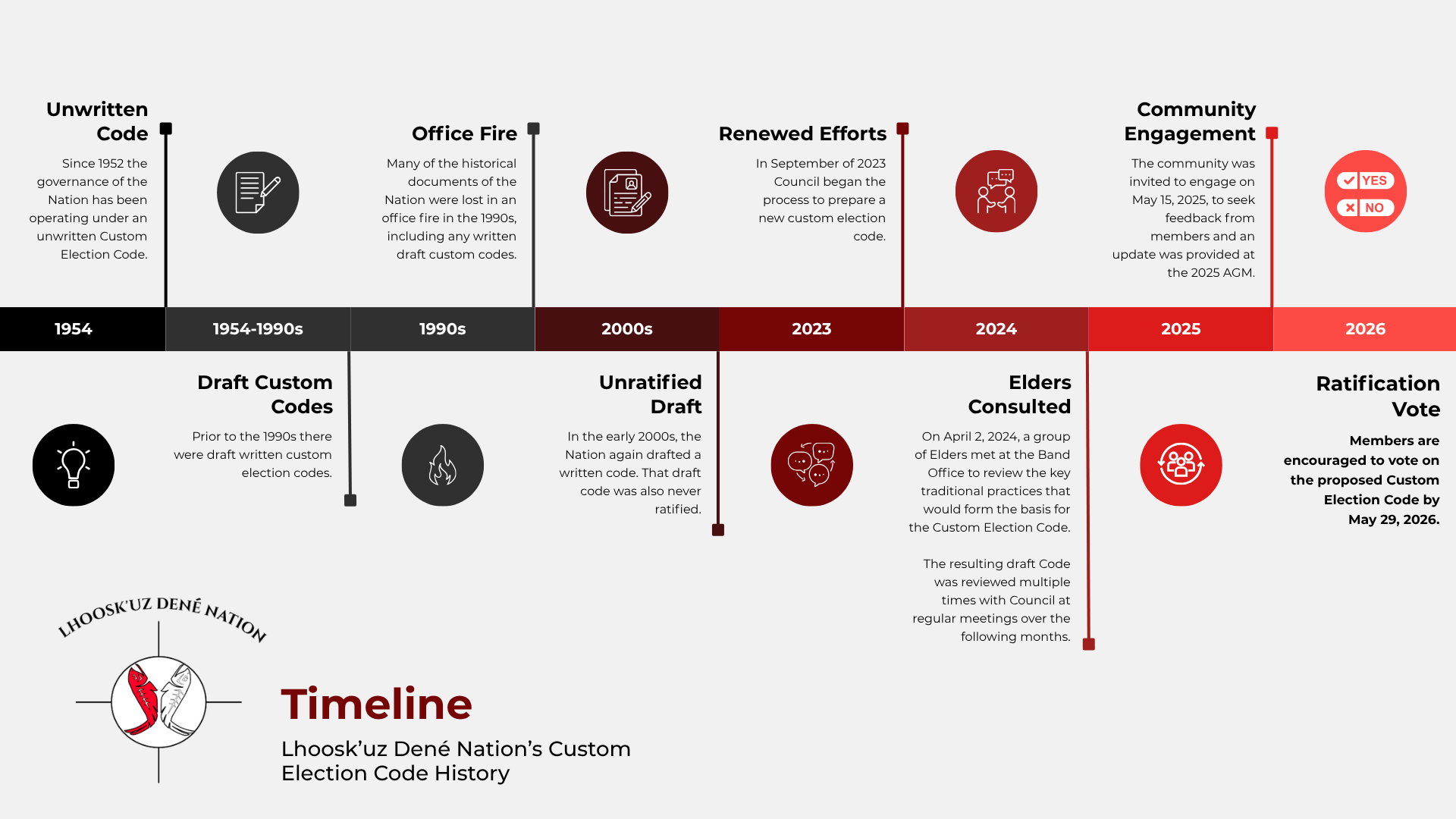
The Nation has held consultations and engagement opportunities since 2024 to help guide development of the proposed Custom Election Code.
These included:
- April 2, 2024: A group of Elders and legal council met at the Band Office to review the key traditional practices that would form the basis for the Custom Election Code.
- May 15, 2025: A community engagement meeting was held to review the draft Code and solicit feedback from members.
- May 28, 2025: Legal council provided an update to members at the AGM.
The ratification vote is the final opportunity for eligible members to make your voice count on whether this proposed Custom Election Code should move forward.
If you support the proposed Code, vote “Yes.”
If you do not support the proposed Code, vote “No.”
Once the Custom Code is ratified, can it be changed – or is it set in stone?
One of the great things about the having a Custom Code is it also defines the rules for making changes to it. This process can be initiated by a petition signed by a majority of all voting members or by a Council Resolution, voting members can provide comments on the proposed changes for Council to review and, and a final decision will be made by members through a petition.
This means the Custom Code can adapt alongside the Nation so that it reflects members’ wishes and realities, both now and in the future.
What If I Can’t Vote on May 15?
There are several ways eligible members can vote:
- Online voting at www.onefeather.ca/nations/lhooskuz/elections/may-2026
- Mail-in ballot, which can be requested by emailing voterhelp@onefeather.ca or calling 1-855-923-3006, if you did not already receive one
- In-person voting on May 15 or May 29 at the Quesnel Seniors’ Centre
Can I Watch the Votes Be Counted?
Yes. Members are welcome, alongside Nation staff and the legal team to observe the ballot count on May 29 after polls close at 7 p.m.